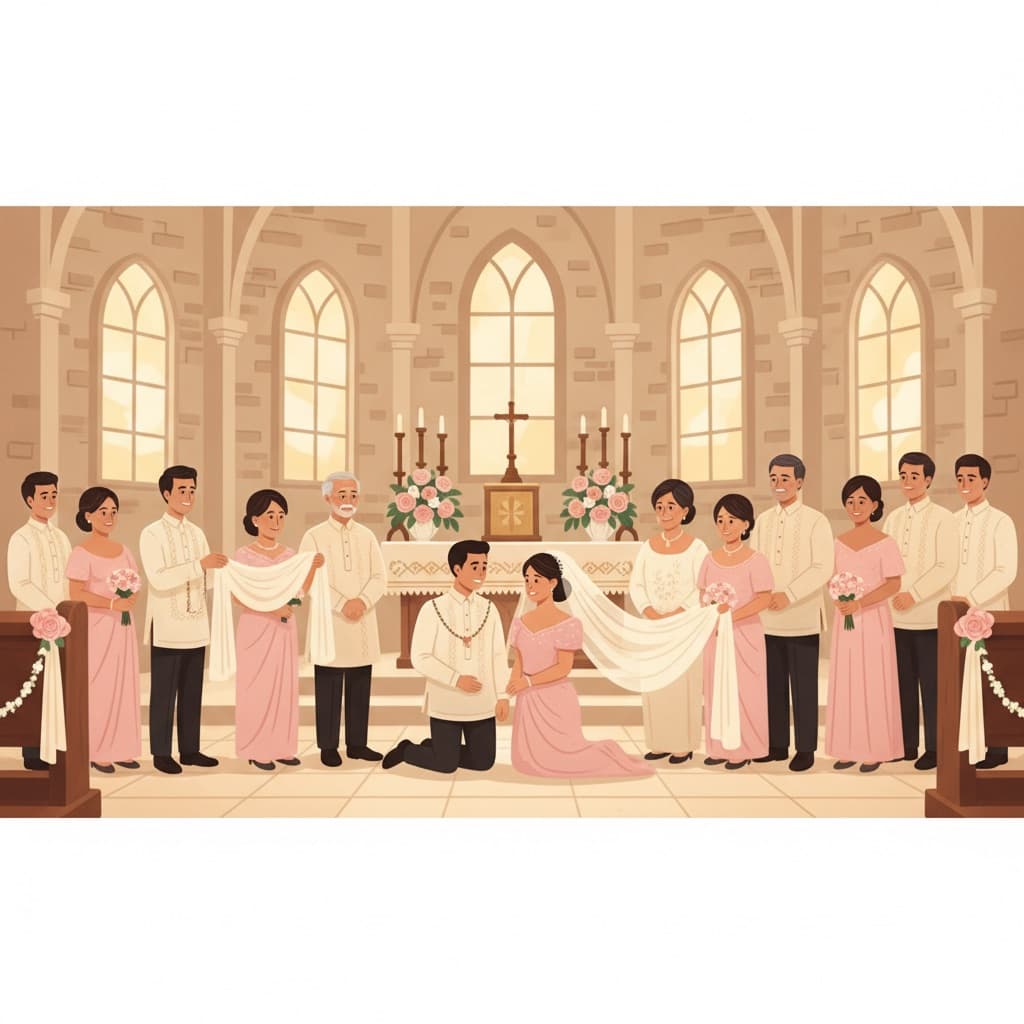
The Filipino wedding entourage is one of the most beautiful — and most complicated — parts of a Filipino wedding. Few other cultures ask this many people to stand up with you, and fewer still give each of them something specific to do during the ceremony.
This is the whole list: who does what, how many of each is normal, when to ask them, and how to keep track of everyone once you have said yes to your third tita's suggestion.
The Principal Sponsors: Ninong and Ninang
The heart of the entourage. These are the couples who serve as your wedding godparents — usually older married couples who have been significant in your life, or in your parents' lives.
Traditionally you have two to four pairs. Modern Filipino weddings often run to ten pairs or more, partly out of affection and partly because principal sponsors are expected to help — with advice, with connections, and often with the wedding itself. They walk in the processional, sit in a reserved section, and are named on the invitation.
There is also a practical reason to choose carefully: your marriage certificate needs witnesses of legal age to sign it, and principal sponsors are usually the ones who do. Pick people who will actually be there, not people you would feel awkward leaving out.
The Secondary Sponsors
These are the sponsors who perform the rituals themselves. Each one has a job during the ceremony, which is why briefing them matters more than choosing them.
Candle sponsors light the two candles flanking the unity candle. The couple then use those two flames to light one — two lives becoming one household.
Veil sponsors pin the veil over the bride's head and across the groom's shoulder, clothing them as one and asking for protection over the home they are starting.
Cord sponsors drape the yugal — a ceremonial cord, often shaped into a figure eight — over the couple's shoulders. The shape is the point: an unbroken bond, without end.
Coin sponsors present the arrhae, the thirteen coins the groom entrusts to the bride. They are blessed by the officiant and stand for provision, shared responsibility, and a household run together.
In most Catholic ceremonies here the order runs candle, then veil, then cord — but your officiant will have their own sequence, and a civil or non-Catholic ceremony may keep some rituals and drop others. Ask early, then tell your sponsors, because most of them will be doing this for the first time.
The Rest of the Entourage
- Officiant — the priest, pastor, imam or judge who solemnizes the marriage.
- Parents of the bride and groom — named on the invitation and in the processional.
- Maid or matron of honor, and the best man — your right-hand people, and the two who will handle whatever goes wrong.
- Bridesmaids and groomsmen — the abay, your squad on the day.
- Flower girls or flower attendants — usually young girls scattering petals ahead of the bride.
- Ring bearer — carries the rings.
- Bible bearer — carries the ceremonial Bible.
- Coin bearer — carries the arrhae down the aisle.
How Many Is Too Many?
There is no rule, only consequences. Each additional pair is one more person in the processional, one more line on the invitation, one more seat to reserve, and one more person your coordinator has to find fifteen minutes before the ceremony.
Two questions settle it faster than any list:
- Will they be there? A sponsor who cannot fly in is a gap on the day.
- Do they know what they are for? Somebody has to hold the cord.
If a venue has a narrow aisle or a tight ceremony slot, ask your coordinator for a number before you ask anyone to be in it.
When and How to Ask
Principal sponsors first, and early — six to nine months out is normal, and longer if they are traveling. They are the hardest group to finalize, and everything else on the invitation waits on them.
Ask in person, or at least by call. A group chat message reads like an announcement, not an invitation. For older sponsors, a visit is the tradition and it is worth the trip.
Be clear about the role. "Ninang" and "cord sponsor" are different asks with different expectations. Say which one you mean.
Then brief them again closer to the day. Send the ceremony order, the call time, and the dress code in writing. Your sponsors will thank you and your coordinator will thank you more.
The Mistakes That Cost the Most
- Listing the same person twice. It happens constantly — someone is a ninang and also a cord sponsor, and gets printed in both places without anyone deciding that was the plan.
- Forgetting the secondary sponsors need instructions. They are the ones on their feet during the ceremony.
- Leaving the entourage off the invitation entirely. For many families this is the part they read first.
- Finalizing the list after the invitations are printed. Print last. Always.
Keeping the List Straight
The real difficulty is not choosing. It is holding ten pairs of principal sponsors, four sets of secondary sponsors, the bearers and the abay in one place, in the order they will be printed, while three relatives suggest additions.
That is what Nupta's entourage section is for. Every role has a dedicated spot, the role names are free text so you can call a group whatever your family calls it, and what you type is what your guests see on your wedding website — no retyping into a separate document for the printer.
If you are not ready to build a site yet, the free entourage builder does the list on its own, and you can copy the result straight into your invitation draft.
Planning your entourage? Try Nupta — free. The entourage section is already built in.
Want a wedding website? Make one free on Nupta.
Try Nupta — Free →